





According to the Mahabharata, King Drupada of Panchal, in his search for a suitable husband for his daughter Draupadi, organised a swayamvar for her: a tournament that required aspiring suitors to perform feats of valour and skill. The man who eventually won – Arjun, the most accomplished archer of all – became Draupadi’s husband (though there’s more to the story).
The Hindu epics are full of stories of swayamvars. Some (including another famous swayamvar, that of Sita in the Ramayana) require the men to show their prowess as warriors; others (like Damayanti, in the Mahabharata) are allowed the freedom of the true meaning of swayamvar: “self-choice”s. The Mahabharata, in fact, has several instances of swayamvars, both feat-driven and not. There is the swayamvar of the three princesses of Kashi, Amba, Ambika and Ambalika; and there’s Kunti, who chose King Pandu – but who had already, before her marriage to Pandu, given birth to a son named Karna.
The third marriage
The protagonist-narrator of the US-based writer of Indian origin Sonora Jha’s Intemperance is never named. But she has a son, from a former marriage, named Karan. And now this woman, a 55-year-old professor of sociology but currently on a sabbatical, twice-divorced, partly disabled because of childhood polio and adulthood accident – decides to give marriage a third chance. By means of a swayamvar, no less.
Unnamed throughout the book, yet brought emphatically to life by Jha, this Seattle-resident woman embarks on a mission to make her swayamvar happen – and her first step is to post about it on social media. The ripple effect of this simple action stretches till the end of the story, because the people who become this woman’s support team are drawn mostly as a result of the sudden and incendiary fame resulting from that social media post. Amidst the flurry of trolling and snide remarks, there are those who applaud this woman’s spirit, and are willing to help her achieve what she’s set out so publicly to do.
There is Demi, a former student, now a wedding planner, who offers to help her ex-professor plan what promises to be a truly unique wedding. There is Vee, a disabled woman who films documentaries, and who wants to record the swayamvar. There is a cake designer, a maker of bridal dresses, a kind florist, and there is the woman’s old friend Cat, unable because of circumstances to be with her through the process, but there in spirit.
And from halfway across the world comes a series of letters from a distant relative of the woman’s, a man named Brajesh. Brajesh tells her the story of an old family curse, its root in a scandalous affair between an ancestor of theirs and a Dalit villager he fell in love with.
As Brajesh’s letters recount the story of Alokendra and Heera, the woman and her small but supportive cohort draw closer to the date she’s chosen for her swayamvar. And, even as she’s juggling her emotions, trying to pin down what she really needs, really desires, the woman finds herself running into some very odd people. There is a woman on the bus, holding a brimming jar of water, a swan by her side (to which she talks!). There is Janaki, whom she meets at a kathak class, and who tries to abduct her. There is a self-confident and sensuous D, whose spirit is inexplicably quenched, her aura diminished, when she’s with the five men she seems to hang out with.
Strength and wisdom
Intemperance is many things. It is a very engrossing story, often witty, but just as often wise, poignant, and hard-hitting. It is magical realism, the characters of the Hindu epics and of Brajesh’s ancestry stepping in and out of the woman’s life. It is homemade kohl, sent by a stranger from India, that helps her see: see herself for what she really is, and see the long-ago past.
It is, too, a comment on so many things that separate us from each other, that come in the way of love of all kinds. Sexism, racism, ageism, ableism, casteism: a whole panoply of isms that serve to put “others” in their place. Through the stories of the protagonist’s ancestors, through her own memories of sexual harassment as a child, through the stories of those who eventually gather around her – the transgender fashion designer, the disabled film-maker, and others – a story is built up of the many ways in which the privileged and the empowered ostracise those not as fortunate as them.
Hearteningly, though, Jha chooses to show her characters surmounting these isms. Whether it’s Heera and Alokendra fighting back against a casteist, homophobic family, or Demi taking her life into her own hands, wheelchair and all, these people show a resilience and a strength of character that is inspiring.
Most of all, the protagonist shines bright and clear as a woman of strength and wisdom, even though it may not come naturally to her. With her weak legs, her sagging skin and too-much-weight, this woman may not meet the stereotypical standards of feminine desirability. Her impulsive decision to have a swayamvar, and several other seemingly harebrained ideas make her, in the eyes of most, unconventional at best, dangerously lunatic at worst. And yet, because we are made privy to her deepest thoughts, we can see the depths in this woman: the pain, the insecurities, the vulnerability.
“I have been on dating apps, and the worst part is the writing of the profile, the responding to the questions, the expressing of one’s desire for a partner with levity without exposing the ravenous, grasping loneliness beneath it.”
The very realness of this woman makes her an extremely compelling protagonist. The others in the story, especially her friend Cat, are also nuanced and interesting characters, vivid and relatable.
The humour in Jha’s writing, balanced by the depth of the message and the eventually charming, heartwarming resolution of Intemperance, makes for a book that’s a rare combination of entertaining and thought-provoking in equal measure.
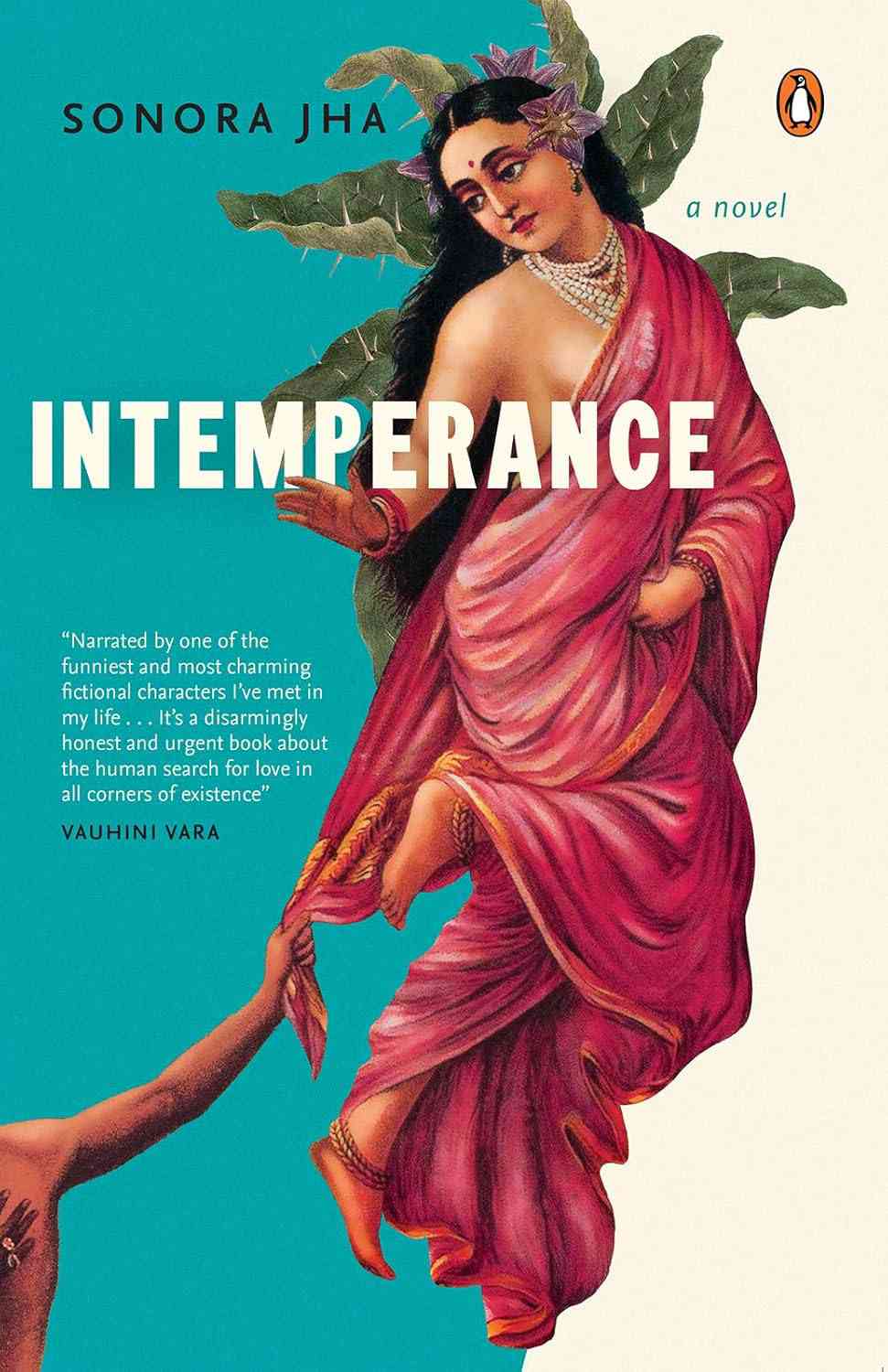
Intemperance: A Novel, Sonora Jha, Penguin Random House India.
